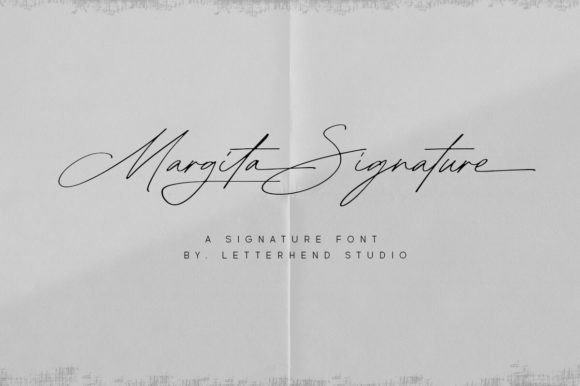
Margita Signature: A Practical Evaluation of a Handwritten Script Font
In the crowded market of digital assets, finding a script font that avoids the common pitfalls of looking artificial or being illegible can be a significant challenge. Many script typefaces rely too heavily on mechanical curves, resulting in a rigid appearance that fails to capture the nuance of human writing. Margita Signature enters this space as a distinct option, designed specifically to emulate the fluidity and imperfections of manual handwriting. For professionals ranging from brand designers to wedding stationers, the difference between a generic script and a convincing handwritten font often lies in the details—the variation in stroke weight and the organic flow of the letters.
This article provides an objective look at Margita Signature, analyzing its technical construction, practical application, and overall value for creative workflows. We will explore how its specific features, such as stylistic alternates and ligatures, contribute to a more authentic presentation and where it fits best within professional design projects.
Technical Construction and Design Philosophy
At its core, Margita Signature is built on the principle of contrast. The defining characteristic of this font is the interplay between the tick and thin stroke. Unlike monoline scripts where every part of the letter has the same thickness, Margita Signature mimics the pressure changes of a pointed pen or a felt-tip marker. This variation in weight is crucial for creating a three-dimensional effect on a two-dimensional plane. When a designer uses this font, the thick downstrokes anchor the text, while the thin upstrokes provide a delicate, airy quality that prevents the text from appearing heavy or blocky.
However, stroke variation alone does not guarantee a realistic result. The true test of a script font lies in its connectivity and variation. This is where the stylistic alternates and ligatures come into play. Without these features, repeating letters (such as the double "s" in "signature" or the double "l" in "all") often look identical, which instantly reveals the text as a digital product. Margita Signature addresses this by offering multiple versions of key characters. When OpenType features are enabled in compatible software like Adobe Illustrator, Photoshop, or InDesign, the font automatically swaps these characters. This ensures that adjacent letters connect smoothly and that the overall texture of the paragraph looks varied and organic, much like a page written by hand.
Practical Application in Branding and Stationery
The primary utility of Margita Signature lies in its application across formal and semi-formal design contexts. It is not a font designed for body text or technical documentation; rather, it is a display typeface intended to evoke emotion and personality.
Logo Design and Branding:
For entrepreneurs and small business owners, a logo serves as the face of the company. Margita Signature is particularly effective for brands that want to project a personal, approachable, or artisanal image. Industries such as fashion, make-up, photography, and boutique consultancy often benefit from a handwritten aesthetic. It suggests that there is a human behind the business, rather than a faceless corporation. However, it is important to consider scalability. Highly detailed script fonts can lose legibility when scaled down very small. Therefore, while Margita Signature works well for the main wordmark, designers should pair it with a clean sans-serif font for sub-headers or taglines to ensure readability across all media.
Stationery and Editorial Use:
The font’s aesthetic is naturally suited for the wedding industry and editorial design. When applied to greeting cards, wedding invitations, or book covers, the "real handwriting" quality adds a layer of intimacy and elegance. For publishers and authors, using Margita Signature on a novel cover can signal the genre effectively—particularly for romance, contemporary fiction, or memoirs. The font performs well on high-contrast backgrounds, such as dark text on light paper or gold foil stamping, where the thick and thin strokes can create a striking visual impact.
Usability and Workflow Integration
A font’s value is also determined by how easily it integrates into a designer's workflow. Margita Signature is generally straightforward to install and use, but to unlock its full potential, the user must have access to software that supports advanced OpenType features.
For the average user working in basic word processors or simple web builders, the font will still render a beautiful script. However, the ligatures and alternates may not activate automatically. This is a common limitation with advanced script fonts. To get the most out of Margita Signature, it is recommended for use in professional design suites. This allows the user to manually select specific alternate characters if the automatic ligature feature does not produce the desired connection between two specific letters.
Furthermore, the spacing (kerning) of the font is a critical factor. High-quality script fonts usually come with extensive kerning tables to ensure letters do not collide awkwardly. Based on the design of Margita Signature, the spacing appears calibrated to handle standard pairings, but designers should always review their specific text. Because the font mimics handwriting, a slight manual adjustment to the tracking (letter spacing) might be necessary depending on the size of the text to maintain that natural, unforced look.
Strengths and Limitations
Every design asset has trade-offs. Understanding these helps in making an informed decision about whether Margita Signature fits a specific project.
Strengths:
- Authenticity: The combination of thick/thin strokes and ligatures creates a convincing handwritten effect that avoids the "computerized" look.
- Emotional Resonance: It effectively conveys warmth, luxury, and personality, making it ideal for client-facing materials in lifestyle industries.
- Versatility in Formal Contexts: It bridges the gap between casual handwriting and formal calligraphy, making it suitable for high-end invitations and branding.
Limitations:
- Legibility at Scale: As with most signature fonts, it is not suitable for small body text. It is strictly a display font.
- Software Dependency: To achieve the "real handwriting" effect with varied characters, the user ideally needs software that supports contextual alternates.
- Language Support: Users working with non-Latin scripts or extensive accented characters should verify the specific glyph support included with the font file.
Target Audience and Recommendations
Margita Signature is best suited for a specific demographic of creators. If you are a freelance graphic designer specializing in wedding invitations or stationery, this font is a valuable addition to your library. It offers a ready-made solution for clients requesting a "handwritten" feel without the cost of hiring a live calligrapher.
For small business owners in the beauty, fashion, or lifestyle sectors, this font can serve as a primary asset for social media graphics and packaging labels. It helps establish a cohesive brand voice that feels personal and curated.
However, if your primary work involves user interface (UI) design, technical writing, or long-form digital publishing, Margita Signature is likely not the right tool. Its stylistic nature makes it difficult to read in dense paragraphs, and it lacks the utility required for functional text.
Conclusion
In summary, Margita Signature is a functional and aesthetically pleasing script font that delivers on its promise of mimicking manual handwriting. Its technical features—specifically the stroke weight variation and OpenType ligatures—provide the tools necessary for creating designs that feel bespoke and human. While it requires a degree of design sensibility to deploy effectively, particularly regarding legibility and software compatibility, it remains a strong contender for projects requiring an elegant, personal touch. For professionals looking to enhance their branding or stationery designs with a realistic signature style, Margita Signature offers a practical and reliable solution.